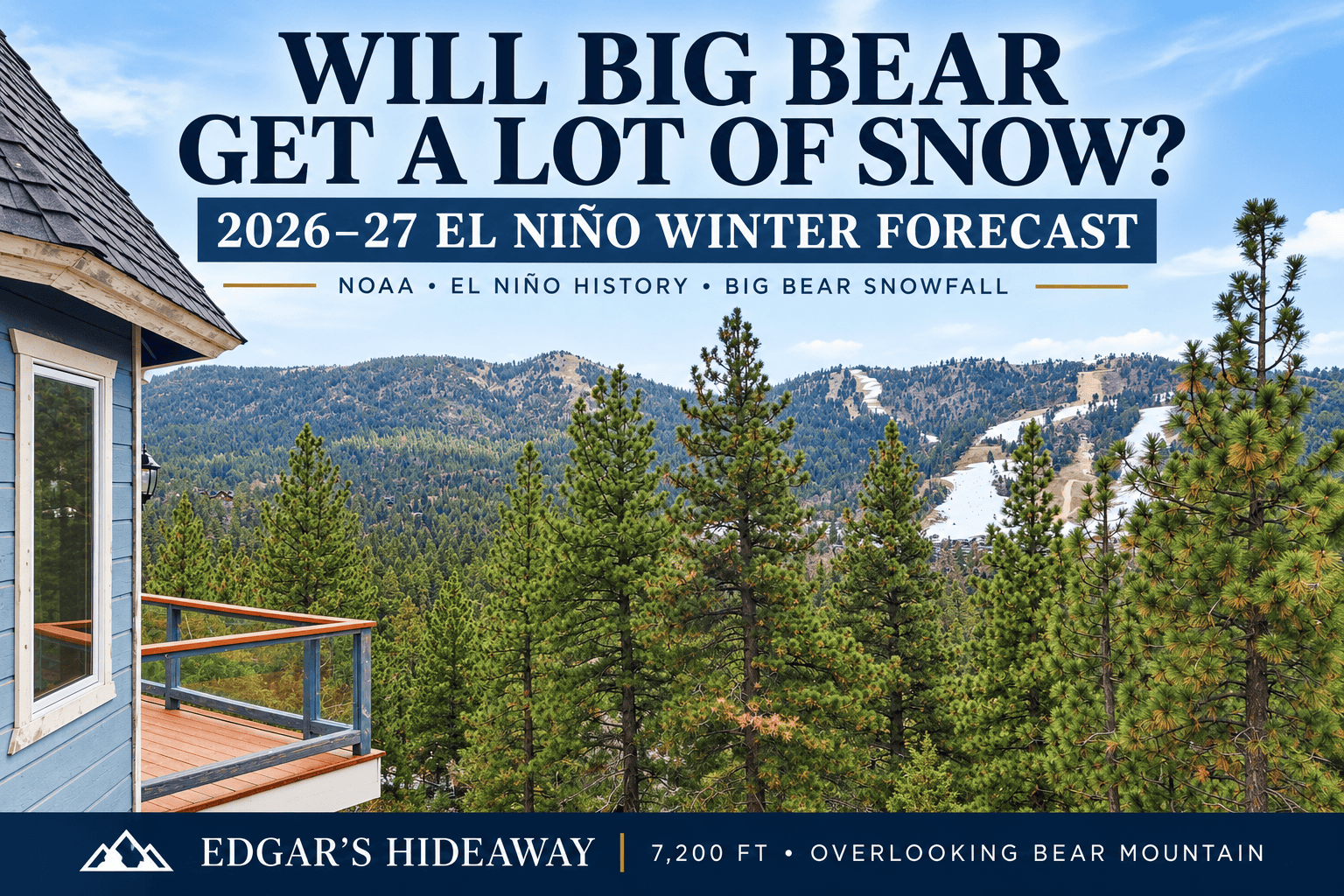
Will Big Bear Get a Lot of Snow This Winter? 2026–27 El Niño Snow Forecast
If you’re wondering whether Big Bear will get a lot of snow this winter, you’re not alone.
The 2026–27 Big Bear winter forecast is becoming particularly interesting. El Niño is strengthening, NOAA says there is a greater than 90% chance it becomes a very strong El Niño, and multiple long-range forecasts point toward a wetter winter pattern across Southern California.
So, naturally, everyone who loves Big Bear wants to know:
Are we going to get a lot of snow this winter?
There are some legitimate reasons to be optimistic. But there’s also a big wildcard.
El Niño can bring Southern California more Pacific moisture, while warmer storms can also mean higher snow levels.
For Big Bear, the question may not be whether we get precipitation.
The question is how much of it falls as snow.
NOAA Says a Very Strong El Niño Is Developing
The official NOAA Climate Prediction Center El Niño Outlook is getting a lot of attention.
NOAA reported in August that El Niño is strengthening and has a greater than 90% chance of becoming a very strong event during fall and winter 2026–27.
Even more remarkable, NOAA currently gives the October–December period a 69% chance of reaching a strength that would exceed previous El Niño events in its record dating back to 1950.
That’s significant.
But NOAA makes an equally important point: even an El Niño of this magnitude does not guarantee the weather impacts normally associated with El Niño.
Think of El Niño as changing the odds.
It doesn’t predict individual storms.
What Does El Niño Mean for Big Bear Snow?
El Niño develops when portions of the tropical Pacific become unusually warm. Those conditions affect atmospheric circulation and can influence the Pacific jet stream and winter storm track.
For Southern California, that can mean more opportunities for Pacific storms and precipitation.
That’s encouraging if you’re hoping for snow.
But here’s the catch:
More precipitation doesn’t automatically mean more snow.
A moisture-packed storm with a snow level around 5,000 or 6,000 feet could produce substantial snowfall in Big Bear.
Take the same moisture and raise the snow level to 8,000 feet, and much of the Big Bear Valley could receive rain instead.
That’s why one of the most important numbers we’ll be watching this winter isn’t simply the precipitation forecast.
It’s the snow level.
For a big Big Bear snowstorm, we want the right combination:
Pacific moisture + cold air + the right storm track.
If those ingredients repeatedly come together this winter, things could get very interesting.
How Much Snow Does Big Bear Normally Get?
Big Bear Lake’s long-term annual snowfall is roughly 59 inches.
Higher elevations can receive considerably more snow, which is particularly relevant for Edgar’s Hideaway.
Our home sits at approximately 7,200 feet in Upper Moonridge overlooking Bear Mountain.
That elevation matters.
During borderline winter storms, a difference of several hundred feet can determine whether precipitation is falling as rain, mixed precipitation or snow.
Last Winter: Only 51 Inches at Bear Mountain
Last winter gives us an excellent comparison.
According to Big Bear Mountain Resort’s official historical snowfall records, Bear Mountain received only 51 inches of natural snow during the entire 2025–26 season.
The monthly totals tell the story:
| Month | Bear Mountain Snowfall |
|---|---|
| November | 9 inches |
| December | 1 inch |
| January | 0 inches |
| February | 41 inches |
| March | 0 inches |
| April | 0 inches |
| Total | 51 inches |
About 80% of Bear Mountain’s natural snowfall last season arrived during February alone.
For comparison, those same resort records show dramatically different recent seasons: Bear Mountain received 79 inches in 2024–25 and 175 inches in 2023–24.
Big Bear snowfall can vary enormously from one winter to another.
So could 2026–27 be dramatically different from last winter?
El Niño history says it could be — but history also gives us a warning.
What Happened During Previous Powerful El Niño Winters?
Some of the strongest modern El Niño events produced very different snowfall totals in Big Bear.
During the powerful 1982–83 El Niño, Big Bear Lake recorded approximately 116 inches of snow.
The famous 1997–98 El Niño produced approximately 77.5 inches.
Then came 2015–16, another exceptionally strong El Niño — and Big Bear Lake recorded only about 48 inches.
Put those three winters together:
| Strong El Niño Winter | Approx. Big Bear Lake Snowfall |
|---|---|
| 1982–83 | 116 inches |
| 1997–98 | 77.5 inches |
| 2015–16 | 48 inches |
That’s the lesson we should remember heading into this winter.
A powerful El Niño can help load the dice toward a wetter Southern California winter. It cannot guarantee a huge Big Bear snow year.
What Does Farmers’ Almanac Predict for 2026–27?
The Farmers’ Almanac 2026–27 Winter Forecast has now been released, and it is also expecting an active southern winter.
Farmers’ Almanac calls for a wet and stormy southern tier and says an active southern storm track should bring heavier-than-normal precipitation from California and the Southwest eastward across the southern United States.
Farmers’ Almanac uses its own proprietary long-range forecasting method, which is quite different from NOAA’s scientific climate forecasting, so we don’t treat the two as equivalent.
Still, it’s interesting that its forecast also points toward a moisture-rich southern winter.
The Old Farmer’s Almanac Is a Different Publication — And It Has Its Own Forecast
Despite their similar names, Farmers’ Almanac and The Old Farmer’s Almanac are two separate publications with their own long-range forecasts.
And the newly released Old Farmer’s Almanac Winter Forecast is particularly interesting for Big Bear.
For the Pacific Southwest, The Old Farmer’s Almanac predicts:
Temperatures: Above normal
Precipitation: Above normal
Mountain snowfall: Near to above normal
It identifies late December, mid-January, early and late February, and early and late March as some of the stormier periods.
In other words, its basic Pacific Southwest prediction is:
Warmer and wetter overall, with near- to above-normal snowfall in mountain areas.
That description gets right to the heart of the Big Bear question.
The moisture may be there.
But will the individual storms be cold enough to turn it into snow?
Rain or Snow? Edgar’s Hideaway Is at 7,200 Feet
This is where elevation becomes particularly important.
Edgar’s Hideaway sits at approximately 7,200 feet in Upper Moonridge overlooking Bear Mountain.
Consider what happens as the snow level changes:
5,500-foot snow level: We’re comfortably above it.
6,500-foot snow level: We’re still above it.
7,000-foot snow level: Every few hundred feet starts to matter.
8,000-foot snow level: We’re potentially looking at rain instead.
That’s why hearing that a huge Pacific storm is headed toward Southern California doesn’t necessarily tell you what’s going to happen at Edgar’s Hideaway.
We need to know how cold that storm will be.
And when a genuinely cold storm taps into the tremendous amount of Pacific moisture that can accompany a strong El Niño?
That’s when Big Bear can get buried.
So, Will Big Bear Get a Lot of Snow in 2026–27?
Nobody can responsibly answer that question yet.
But there are legitimate reasons for skiers and snowboarders to be optimistic.
NOAA says there is a greater than 90% chance of a very strong El Niño.
Farmers’ Almanac is forecasting a wet and stormy southern tier, including heavier-than-normal precipitation extending from California and the Southwest.
The Old Farmer’s Almanac forecasts the Pacific Southwest to be warmer and wetter overall, with near- to above-normal mountain snowfall.
And history tells us powerful El Niño winters have produced some impressive Big Bear snowfall seasons.
But history also tells us they don’t always do so.
The moisture looks promising. The cold air remains the wildcard.
Bring the Whole Group — Edgar’s Hideaway Sleeps 16
If the snow does start piling up this winter, why split everybody among several cabins?
Edgar’s Hideaway sleeps up to 16 guests at approximately 7,200 feet in Upper Moonridge overlooking Bear Mountain.
Bring the whole group.
Bring the extended family.
Bring several families together.
Bring your ski and snowboard crew.
Wake up in the mountains overlooking Bear Mountain, grab the boards and get ready for the day.
Snowboard Bear Mountain. Ski Snow Summit.
Let’s go boarding.
And after a day on the mountain, everybody comes back to the same house to spend the evening together.
Planning New Year’s in Big Bear?
Winter break is also a great opportunity to turn a ski trip into several days in the mountains.
We’ve put together a separate guide to New Year’s in Big Bear 2026–27, including Bear Mountain snowboarding, Snow Summit skiing, The Village, night sessions and Snow Summit’s New Year’s Eve Torchlight Parade.
That article should be internally linked here on Edgar’s Hideaway rather than treated as a separate island of content.
And if you’re bringing the whole family, Edgar’s Hideaway sleeps 16 and has a five-night minimum over New Year’s.
See our pages, Big Bear Holiday Cabin and New Year Holiday stay
Coming to Big Bear This Winter? Always Check Ben’s Weather
Long-range winter forecasts are interesting and useful for understanding what the season might look like.
They’re not what you should use to decide whether to drive up the mountain on a particular Friday afternoon.
When you’re actually coming to Big Bear, always check Ben’s Weather before your trip.
Ben’s Weather focuses specifically on Big Bear’s local mountain weather and conditions.
When a storm is approaching, pay attention to:
- Expected snowfall
- Snow level
- Storm timing
- Wind and temperatures
- Road conditions and chain requirements
Big Bear’s weather can be dramatically different from conditions down the mountain, particularly at higher elevations.
We’ll use NOAA to follow the big-picture El Niño story.
When an actual storm is coming to Big Bear, we’ll be checking Ben’s Weather.
The Bottom Line: Is Big Bear Going to Have a Snowy Winter?
Maybe — and this is certainly a winter worth watching.
Big Bear Lake normally receives roughly 59 inches of snow annually.
Last year, Bear Mountain received only 51 inches of natural snow.
Now NOAA says El Niño has a greater than 90% chance of becoming very strong, with a 69% chance of reaching a strength during October–December that would exceed previous events in its modern record.
Both Almanac forecasts are also pointing toward a wetter southern or Pacific Southwest winter, with The Old Farmer’s Almanac specifically predicting near- to above-normal mountain snowfall.
So we’re watching closely.
The moisture may be there.
The big question is whether the cold air will be there with it.
If it is, Big Bear could have a very different winter than last year.
And if the snow starts piling up?
Bring the whole group. Edgar’s Hideaway sleeps 16 at 7,200 feet in Upper Moonridge overlooking Bear Mountain.
Grab the skis.
Grab the snowboards.
Snowboard Bear Mountain. Ski Snow Summit.
Let’s go boarding. Check Availability
We’ll continue updating this Big Bear winter forecast for 2026–27 as NOAA releases new information and the first winter storms begin appearing in the local forecast.
Updated September 2026. Seasonal forecasts describe probabilities and cannot predict individual storms or guarantee snowfall.